Project overview
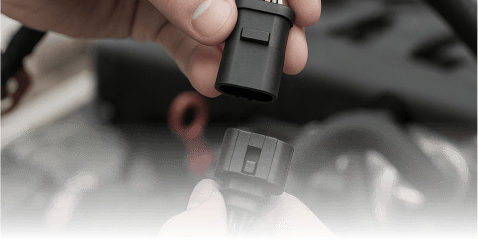
Listen AI recognizes the 'click' a connector makes when it is fully seated, and confirms both whether it was fastened and how many times. It catches by sound what vision inspection misses — missed fastening, fastening an operator overlooked, and fastening in places the eye cannot check, such as the underside. Deeply has deployed connector fastening sound inspection on the production lines of several global OEMs
Field challenge
Vision inspection could not detect fastening deep in places it cannot see, such as the underside of the car body. A connector could look fastened and still not be
Parts located at the underside, such as hybrid connectors, were hard for operators to check by eye
Even with vision inspection in place, the floor often did not trust its results right away. Limited customization by vision vendors and the difficulty of tracing the cause of a problem were raised again and again
Torque tools measure torque and rotation angle, but torque can still read normal when a screw is cross-threaded, stripped, or broken. As long as the values matched, the part passed, and missed fastening slipped through
Customer tasks
- Catch the missed fastening that vision inspection and operators overlook
- Confirm fastening at the underside and other hidden positions
- Count the fastenings made in one cycle
- Double-check bolt fastening faults that torque values alone miss
Site conditions and constraints
- Assembly line mixing neighboring-process noise, drills, fan noise, and body resonance
- Several connector types on one line
- Fastening sound that varies with operator posture, microphone position, gloves, and fastening speed
- Two operators fastening at the same time
- Line running 24 hours in three shifts
Deployment and system setup
- Handheld or fixed acoustic sensors, chosen to suit the site
- Pickup directivity tuned to reduce recognition differences by microphone position
- Sensor mounted on the robot-arm gripper for robotic fastening
- Closed-network setup that analyzes at the edge and sends only results
- PLC integration by default, with results passed to existing MES and vision systems
Results at a glance
| Item | Before | After |
|---|---|---|
| Judgment | Vision inspection or operator check | Sound-based inspection of the fastening sound, 99.87% accuracy |
| Limits of vision | Cannot detect fastening deep in unseen places such as the body underside. A connector can look fastened and still not be | Judged by the fastening sound, regardless of appearance |
| Underside and hidden positions | Positions out of sight, such as hybrid connectors, cannot be checked | Checked by sound regardless of position |
| Blind spot of torque | Passes whenever torque and angle match (misses missed fastening and breakage) | Confirms actual fastening from the sound at the moment of fastening |
Why sound
Why vision falls short
Parts at the underside, such as hybrid connectors, are often hard to check by eye right away. Even with vision inspection in place, limited customization and the difficulty of tracing causes mean the floor often does not trust its results right away
Why torque sensors fall short
Torque tools measure torque and rotation angle, but torque can still read normal when a screw is cross-threaded, stripped, or broken. The same holds for connectors and bolts. Without listening for the 'click' at the moment fastening completes, sensor values alone let missed fastening through
Why sound works
The sound of a connector seating fully is a clear, event-like signal that a microphone can pick out well. Sound carries even when the position is hidden, so it works at assembly positions without a clear line of sight. Acoustic sensors can be carried by hand or mounted in place, so the setup can be chosen to suit the site
How we approach it
- Learn each connector type as a class — fastening sounds of different connectors are learned as separate classes
- Collect data across noise conditions — recognition is validated under normal, music, drill, and other noise
- Optimize microphone directivity — pickup directivity is tuned to reduce differences by microphone position
- Tune response time — time to a fastening judgment is matched to line speed
Deployments
OEM vehicle assembly line (Inter QC)
We reviewed connector fastening sound inspection for export vehicles. Five connector types were validated under normal, factory-noise, and drill-noise conditions, with positive results for production-line use
Automotive parts maker (battery connectors)
Recognition worked well for both single and sequential fastening, and the inspection is now in use on the production line
Robotic connector fastening
For a process where robots, not people, do the fastening, a sensor on the robot-arm gripper recognizes the fastening sound
Hybrid parts maker
On a line running 24 hours in three shifts, fastening of nine connectors is checked by sound. Hybrid connectors are hard to check by eye because of where they sit, which makes sound-based inspection especially suitable
Global heavy equipment maker
Bolt fastening faults that torque values alone can miss are double-checked by sound. It applies the same principle as the connector click to bolt fastening
Questions before adoption
Our plant is loud. Will it still work?
How loud a site is and whether the target sound can be separated are different questions. With directional microphones and source separation, only the target fastening sound is picked out even in high-noise environments
Can we operate and retrain it ourselves?
For the first year after adoption, Deeply maintains accuracy directly; after that, operation moves to the customer so you can retrain on your own. The timing and scope of the handover are agreed before adoption
Can it run on a closed network?
It can be set up to analyze at the edge and send only the results, so it works in secure environments with restricted external connectivity
Can we start on a small budget?
Microphone-based setups have low hardware costs, so you can validate with a small PoC first and expand afterwards
Does it integrate with existing MES, vision, and CMMS?
PLC integration is the default, and results can be passed to existing systems in various forms
What happens after you contact us
- Site assessment — we check line noise, connector types, and microphone positions
- PoC — recognition is validated on a small line
- Validation — accuracy is checked under various noise conditions and judgment criteria are agreed
- Rollout — expansion proceeds line by line from the validated ones
Outcome summary
Measurement conditions and limitations
- Measurement conditions
- In the OEM assembly-line review, recognition was validated on five connector types under normal, factory-noise, and drill-noise conditions
- Limitations
- Recognition performance depends on connector type, line noise, and microphone placement. Each site is confirmed with a PoC first, and judgment criteria are agreed afterwards
Published
Explore this case with AI
Send this page URL to a new conversation