Project overview
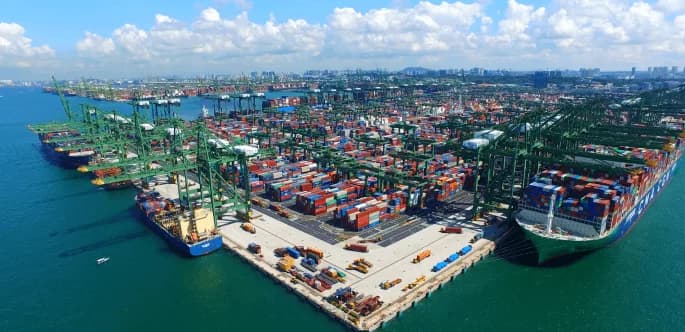
A single hour of downtime on large port cranes and rotating equipment can seriously disrupt logistics. Detecting crane wire or bearing faults with vibration sensors brings many false alarms, and contact sensors can only be mounted in limited places. Deeply is running field trials of sound-based predictive maintenance with a large Singapore port operator, a Korean port, and a UK port city
Field challenge
Even in normal operation, cranes get louder and vibrate more when they accelerate while lifting containers or run under high load. Telling normal operating changes from real anomalies was the core challenge
Ports must run 24 hours without interruption, so downtime is costly
The marine environment imposes demanding hardware durability requirements such as waterproofing and dustproofing
Contact sensors can only be mounted in limited places, and on equipment as large as cranes they risk wear and damage. The noise sensors used at some sites had room to improve in accuracy and operating cost
Customer tasks
- Predictive maintenance for wire vibration inside crane wheels
- Move from repair-after-inspection to catching early signs of anomalies
- Integrate with existing alarm systems and digital twins
Site conditions and constraints
- 24-hour uninterrupted operation
- Marine environment requiring waterproof and dustproof ratings and certifications
- High-noise environment dense with large equipment
- Port and marine environment where communication can be unstable
Deployment and system setup
- Continuous monitoring with non-contact microphones
- Analysis at the edge, sending only results
- Results passed to existing control and alarm systems
Deeply's approach
| Item | Conventional | Deeply |
|---|---|---|
| Detection | Vibration and noise sensors (contact) | Non-contact detection through continuous sound monitoring |
| Maintenance | Periodic inspection, repair when problems occur | Direction confirmed for catching early signs sooner |
| Installation | Limited mounting positions, wear and contact to maintain | Simple installation with non-contact microphones |
| Expansion | — | Field trials running in parallel across Singapore, Korea, and the UK |
Why sound
Why vibration and noise sensors fall short
Contact sensors can only be mounted in limited places, and on equipment as large as cranes they risk wear and damage. Some sites use noise sensors, but we see room to improve in accuracy and operating cost
Why sound works
Being non-contact, it is simple to install, and the market has told us it is more accurate than existing vibration sensors. In ports dense with large equipment, the lighter installation and maintenance burden stands out as a strength
How we approach it
- Learn normal operating patterns — normal operating sound, including acceleration and high-load segments, is learned first
- Set criteria for anomalies — criteria are defined to tell normal operating changes from real anomalies
- Review hardware for site conditions — waterproof and dustproof ratings and certifications for the marine environment are reviewed together
- Run trials in several regions at once — data from varied equipment in several countries broadens the validation
Deployments
Large Singapore port operator
We are reviewing predictive maintenance for wire vibration inside crane wheels. The operator can consider switching once an accuracy and operating-cost advantage over its existing noise sensors is confirmed
Korean port
A field trial is running at a port with digital-twin infrastructure, and integration with its alarm system is being reviewed
UK port city
Working with a local partner, we are expanding predictive maintenance for large cranes and container-handling equipment. Ports and logistics are core national infrastructure in the UK, so investment in this area is active
Questions before adoption
Our port is loud. Will it still work?
How loud a site is and whether the target sound can be separated are different questions. With directional microphones and source separation, only the target equipment's sound is picked out even amid typical port noise
Can we operate and retrain it ourselves?
We aim to provide an operating model that allows retraining on site, and agree the scope and approach before adoption
Does it work where communication is unstable?
An edge setup that analyzes locally and sends only results can be considered, so it can be configured to run reliably in port and marine environments with unstable communication
Can we start on a small budget?
Microphone-based setups have low hardware costs, so you can validate with a small field trial first and expand afterwards
Does it integrate with existing alarm systems or digital twins?
Results can be passed to existing control and alarm systems
What happens after you contact us
- Site assessment — we check equipment types, operating patterns, and noise and environmental conditions
- Field trial (PoC) — recognition is validated on a small set of equipment
- Validation — criteria for telling normal operation from anomalies are agreed together
- Rollout — expansion proceeds equipment by equipment from the validated ones
Outcome summary
Measurement conditions and limitations
- Limitations
- All three regions are still in field trials. The Singapore port operator is confirming the accuracy and operating-cost advantage over its existing noise sensors, and results will be summarized again once confirmed
Published
Explore this case with AI
Send this page URL to a new conversation